


What Is a C-Clip Rear Axle? Pros, Cons, Jeep Models & Upgrade Options

Updated: Aug 19
If you've spent any time working on rear axles, you've probably heard the phrase "It's a C-clip axle." It's also a common phrase with the Jeep YJ community concerning the Dana 35 and the Ford 8.8 axle upgrade. Depending on who says it, it may sound like a bad thing or just another axle design.
The truth is that C-clip axle retention has been used successfully by many manufacturers for decades. While it does have some disadvantages compared to a "non-C-clip" bolt-in axle design, millions of trucks, SUVs, and passenger cars have accumulated hundreds of thousands of miles without issue.
This guide explains what a C-clip rear differential is, how it works, which Jeep models use them, other manufacturers that utilize this design, and possible upgrades (depending on the axle, whether the upgrade is worth the time and money).
What Is a C-Clip Rear Differential?
A C-clip rear differential is a type of axle shaft retention where the axle shafts are held inside the differential/carrier by a small horseshoe-shaped steel clip called a C-clip.
Instead of the wheel bearing or axle flange physically retaining the axle in the housing, the axle shaft slides completely into the differential with NOTHING holding the axle shaft in at the flange end. Near the inner end of the axle shaft is a machined groove where the C-shaped clip slides in.
A center pin (sometimes called a cross shaft) inside the differential keeps the clips from falling out.
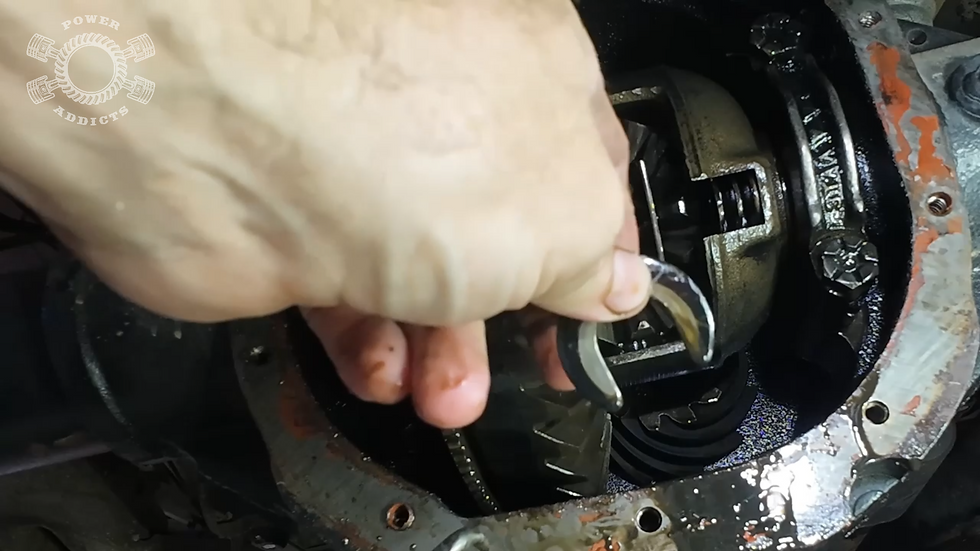
The retention process works like this:
The axle shaft is slid into the housing.
The shaft is pushed inward.
A C-shaped clip is installed into the groove at the splined end of the axle shaft.
The axle is pulled outward, seating the clip against the spider gear. The spider gear has a recessed "circle" that prevents the C-clip from falling off the end of the axle shaft.
The differential center pin is reinstalled, preventing the axle shaft from moving inward, therefore capturing the clips inside the "circle" of the spider gears mentioned above.
It's an inexpensive, compact, and reliable design that manufacturers have used since the 1960s.
How Can You Tell If an Axle Uses C-Clips?
One quick way is by looking at the axle flange where the brake backing plate bolts on.
Most C-clip axles do not have a retainer plate behind the brake backing plate. Instead, the axle simply slides into the housing. With the brake rotor/drum off, you can actually move the axle shaft in and out of the axle housing about 1/8".
For axle shaft removal:
Remove the differential cover
Drain the gear oil
Remove the cross pin retaining bolt
Slide the center pin out
Push the axle inward
Remove the C-clip
Pull the axle out
If you have to remove the differential cover just to pull an axle shaft, chances are it's a C-clip axle. Check the bottom of the page for videos about C-clip axles.

Advantages of C-Clip Rear Axles
Despite the criticism they sometimes receive, C-clip axles offer several advantages.
Lower Manufacturing Cost
C-clip designs require fewer parts than bolt-in axles, making them less expensive to manufacture.
Easier Assembly
During production, axle installation is very fast.
Workers simply insert the shafts, install the clips, and reinstall the center pin.
Compact Design
Without external bearing retainers, the axle housing is simpler and slightly lighter.
Simple Axle Replacement
Replacing an axle shaft is straightforward once the differential cover is removed.
No bearing press is typically required just to remove the shaft.
OK... let's be real. Except for the "Simple Axle Replacement", we as automotive or off-road enthusiasts could not care less about the manufacturing "ease". We care about ease of replacement, strength, and reliability.
Non-C-clip axles such as the Dana 44 aren't too difficult to swap axles if you leave a bearing pressed onto the trail spare. Honestly, they are easier and can be much less messy since you don't have to remove the diff cover. It's 4 bolts ... swap axle shaft .. done. Still not as easy as a full float 14-bolt, but that is another topic for another day.
Proven Reliability
Millions of:
Jeeps
Chevrolet trucks
GMC trucks
Dodge trucks
Ford passenger cars
SUVs
have accumulated well over 200,000 miles using C-clip axles.
My 2005 Tahoe has over 340,000 miles on that C-clip axle ... no issues!!
Disadvantages of C-Clip Axles
The biggest criticism involves safety after an axle shaft failure.
Broken Axle Shaft Can Allow Wheel Separation
If an axle shaft breaks inside the wheel bearing, nothing outside the housing retains the axle.
The entire axle shaft, wheel, and tire can potentially slide out of the housing.
Although catastrophic axle failures are relatively uncommon on stock vehicles, this possibility is why many off-road enthusiasts prefer bolt-in axle designs.
There is an exception to this. For example, the Ford 8.8 in the 1995 and up Ford Explorers has factory disc brakes. The brake rotor and caliper prevent the axle from sliding out if you break it. This is a super popular upgrade swap for Jeep YJs and TJs to step up to a much stronger axle than the Dana 35. Here is a video of doing an 8.8 swap on a 1993 Jeep Wrangler YJ.
Differential Must Be Opened
Replacing an axle shaft requires:
Removing the cover
Draining gear oil
Removing the center pin
This adds time compared to bolt-in designs.
Cross Pin Removal
Some lockers and limited-slip differentials make cross pin removal more difficult.
Certain gear ratios can also interfere with removing the center pin because the ring gear blocks it.

Less Desirable for Extreme Off-Roading
Vehicles running:
37+-inch tires
High horsepower
Aggressive rock crawling
often benefit from stronger bolt-in axle systems.
Jeep Models That Use C-Clip Rear Axles
Jeep has used both C-clip and non-C-clip axle designs depending on the axle model.
Here are the most common factory applications.
Dana 35 (C-Clip)
The Dana 35 is probably the best-known Jeep C-clip axle.
Factory applications include many:
1987–1995 Wrangler YJ
1997–2006 Wrangler TJ (most non-Rubicon models)
1984–2001 Cherokee XJ
1993–1998 Grand Cherokee ZJ
Some Liberty KJ models
The Dana 35 is a semi-floating axle with 27-spline axle shafts in most Jeep applications and uses C-clips to retain the shafts.
While adequate for stock tires, it has developed a reputation for breaking axle shafts when used aggressively with oversized tires and locking differentials.
If you don't wheel hard, you can possibly get away with running a 33" tire. When I went to 35s, I gutted 2 Dana 35s. Then I did the Ford 8.8 swap and have BEAT that diff while running 35s... no issues!! Ford 8.8 for the WIN!!
Chrysler 8.25 (C-Clip)
The Chrysler 8.25 rear axle became common in:
1991–2001 Cherokee XJ
Some Comanche MJ pickups
Most later versions feature 29-spline axle shafts, making them significantly stronger than the Dana 35.
This axle also uses C-clips.
Many Jeep owners consider the Chrysler 8.25 an excellent budget upgrade from the Dana 35. Seriously, the Chrysler 8.25 is a great axle. But the Ford 8.8 is still stronger!! Actually, the 8.8 is stronger than the Dana 44.
Chrysler 8.25 vs Dana 35
The Chrysler axle offers:
Larger axle shafts
Larger ring gear
Better strength
Better aftermarket support
Both use C-clips.
Dana 44 (Jeep Applications)
Factory Jeep Dana 44 rear axles generally do not use C-clips.
Examples include:
TJ Rubicon
LJ Rubicon
Numerous aftermarket Dana 44 housings
These use bolt-in axle shafts retained by external bearing retainers by the brake backing plate.
Dana 44HD (JK Rubicon)
The JK Rubicon Dana 44 also uses bolt-in axle shafts rather than C-clips.
Jeep JK Dana 35
Some early JK Sport models were equipped with the Dana 35 rear axle, which also uses C-clips.
Other Vehicles That Use C-Clip Rear Axles
C-clip axles are extremely common across the automotive industry.
Examples include:
General Motors
Chevrolet Silverado 1500
GMC Sierra 1500
Tahoe
Yukon
Camaro
Firebird
S-10
Blazer
Common axle models:
GM 10-bolt
GM 12-bolt (many versions)
8.5-inch 10-bolt
8.6-inch 10-bolt
Ford
Many Ford passenger cars use C-clips, including:
Mustang 8.8
Crown Victoria
Explorer 8.8 (1995 and up for YJ / TJ swaps)
Interestingly, while the Ford 8.8 uses C-clips, it has earned an excellent reputation for strength. For the people who still wanna throw in that phrase "its still a C-clip axle". Meaning if you break an axle shaft it will come out of the axle housing. Get the disc brake version .... PROBLEM SOLVED!!
The cross pin bolt torque spec is 20 ft-lbs. It's a small bolt, so don't break it off inside that carrier. It is NO fun getting out! Click here for a video of me removing one.
Chrysler / Dodge / Ram
Many models use C-clips, including:
Dodge Ram 1500
Dakota
Durango
Charger
Challenger
Depending on axle model.
Passenger Cars
Many sedans and SUVs from numerous manufacturers also use C-clip axle retention because it is economical and reliable for normal street use.
Common Misconceptions
"All C-Clip Axles Are Weak"
False.
The retention method does not determine axle strength.
For example:
Dana 35 = relatively weak
Ford 8.8 = very strong
GM 12-bolt = very strong
The axle housing, shaft diameter, spline count, and ring gear size determine overall strength.
"C-Clips Frequently Fail"
Not exactly.
The clips themselves rarely fail.
Instead, axle shafts can break under severe abuse.
When that happens, the C-clip design allows the broken shaft to slide out unless you have the disc brake version. Then the brake rotor and caliper hold the axle shaft in the housing.
Upgrade Options
If you're keeping a C-clip axle, there are several ways to improve reliability.
Limited Slip
Many of the C-clip axles come from the factory with limited slip installed. Being an old Jeep fan like the CJs and YJs, my main rear swap axle is the Ford 8.8. They come in various different gear ratios and some with limited slip. If you are thinking of doing this swap, make sure to get one with factory disc brakes. They have larger axle shafts, and the brake rotor and caliper act as a way to hold the shaft in the housing in the unlikely event you break an axle shaft.
Stronger Alloy Axle Shafts
Companies such as Yukon Gear & Axle, Revolution Gear & Axle, and Ten Factory offer stronger chromoly axle shafts for popular axles like the Dana 35 and Chrysler 8.25.
These shafts significantly increase resistance to twisting and breaking.
I'm running Superior Axle brand in my 1984 Mustang GT that has had the 8.8 swapped in.
C-Clip Eliminator Kits
Some aftermarket companies offer C-clip eliminator kits.
These replace the factory axle retention system with bolt-on bearing retainers.
Benefits include:
Prevent wheel loss after an axle break
Easier axle service
Added peace of mind for drag racing
However, some eliminator kits are intended primarily for drag racing and may not be ideal for heavy off-road articulation or daily street use because certain bearing styles are less tolerant of side loads.
If you are junkyard hunting to 8.8 swap your Jeep, just get one with rear disc brakes. The caliper and rotor will hold the axle shaft in if you happen to break it.
Upgrade to a Stronger Axle
Rather than investing heavily in a weaker axle (for example, the Dana 35), many Jeep owners upgrade entirely.
Popular swaps include:
Dana 44
Ford 8.8 (I've done this in a few YJs)
Chrysler 8.25 (for Dana 35 owners)
Dana 60 or 14-bolts (extreme builds)
These options provide stronger housings, larger axle shafts, and greater aftermarket support.
Differential Upgrades
Adding a quality limited-slip differential or selectable locker can improve traction, but remember that increasing traction also increases stress on axle shafts. If you plan to run larger tires or a locker, upgrading the axle shafts—or the entire axle—should be part of the plan.
Save yourself some money and stress; don't lock a Dana 35. Upgrade to the 8.8, then add a locker to it if the 8.8 doesn't already have a factory limited-slip (mine and Jeremy's have the factory limited-slip .. no locker needed).
Is a C-Clip Rear Differential Bad?
Not necessarily.
For stock or mildly modified vehicles, a C-clip axle is perfectly adequate. Millions of drivers never experience an issue during the life of their vehicle.
Problems typically arise when a relatively light-duty axle, such as the Dana 35, is subjected to conditions it wasn't designed for, including large tires, aggressive locking differentials, high-horsepower engines, or hard rock crawling.
If your Jeep is used primarily for commuting, trail riding on moderate terrain, or weekend adventures with stock-sized tires, a properly maintained C-clip axle can provide years of reliable service. However, if you're building a serious off-road rig, planning to install 35-inch or larger tires, or routinely tackle difficult obstacles, upgrading to a stronger axle is a worthwhile investment.
Ultimately, the presence of C-clips alone shouldn't determine whether an axle is considered "good" or "bad." The axle's overall design, intended use, and maintenance history are far more important factors. Understanding the strengths and limitations of your specific rear axle will help you make informed decisions about modifications and ensure your Jeep remains dependable both on and off the trail.
Comments